
Dr. Helaine Smith is excited to welcome more and more young families to Pound Ridge and the surrounding areas. Dr. Mensah, a mother of two young children, knows the struggles of at-home oral hygiene and would like to share some of her oral care routines and tips.
When should your child first visit the dentist?
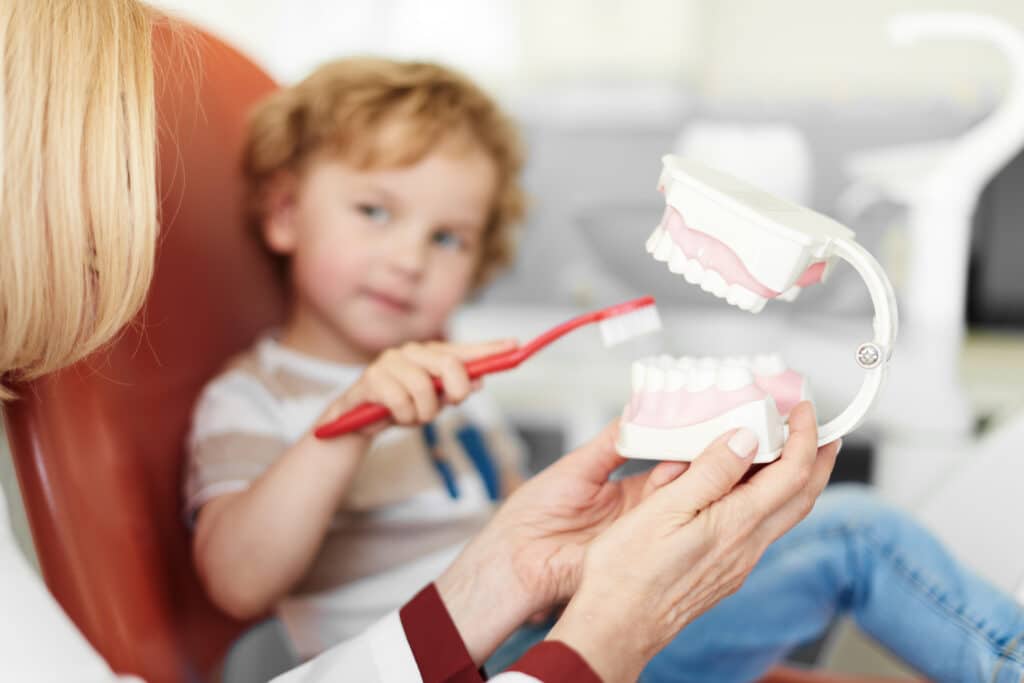
Ideally, a child should visit a dentist by age 1. This may seem very early, considering some children might not even have teeth by then! However, pediatric dentistry is not only about looking for cavities, but it’s also really about anticipatory guidance.
What this means is giving you, as a parent, tips and tricks on when to brush, how to brush, what toothpaste to use, if vitamins with fluoride should be given, the best snacks and drinks to give your children, when to stop using pacifiers and bottles, when you intervene to stop habits, when to start flossing, to identify tongue or lip ties, to identify if they have the correct number and sequence of baby teeth, etc. It’s really about catching issues early and taking care of the child’s mouth as a whole before they become bigger issues. All recommendations are based on the child’s age, development, and environment.
We really hope for children to simply have check-ups every six months until they graduate from pediatrics and start seeing an adult dentist. The more likely they are to come in for preventative services, the less likely they are to need treatment. The less treatment children receive at a young age, the more likely they are to have a happy and healthy relationship with their dentist and their teeth.
What should I expect at my child’s first dental visit?
A child’s first visit often involves a lot of anticipatory guidance, as mentioned above, which is based on the child’s age and development. It involves a multitude of questions about the child’s medical history, diet, habits, oral hygiene, developmental milestones reached, previous mouth-related accidents, and any concerns the parent may have coming into the visit. Subsequently, the dentist will perform a comprehensive exam, a cleaning, and a fluoride varnish. Often, due to behavior and underlying medical conditions, some aspects of the visit may be slightly different to cater to the child’s needs. For instance, a child with autism who has sensory issues may not be comfortable with a tool that makes a loud noise, so other methods may be considered to have the child complete the visit, but also be comfortable.
Why Choose Pound Ridge Cosmetic Dentistry as your Pediatric Dentist
It’s always nice and convenient to have all family members seen in one office, so it’s incredible that at Pound Ridge Cosmetic Dentistry, children can be seen as well. General dentists’ training in pediatrics is limited to their dental school experiences.
A pediatric dentist has at least two years of additional training in a hospital-based or hospital-affiliated program that is rigorous and limited to seeing children, including children with medical and special needs. It often includes various new techniques and materials for delivering the best options for your children with minimal trauma as necessary. Because pediatric dentists treat children all day, every day, they are exposed to a wide range of behaviors and conditions that general dentists often aren’t well-versed in. Pediatric dentists are trained to be patient, mindful of a child’s behavior, and to explore options that are best for your child and your family, depending on factors we discuss. General dentists often refer children to pediatric dentists if they cannot cooperate or have behavioral issues, or if the child needs treatment that the general dentist is not equipped to deliver. It would be best to bypass all this by having your child seen at a young age (1 year old), so we can monitor all their conditions and so they can build a relationship with their pediatric dentist and trust them when the time comes for treatment to be delivered. That’s what builds a healthy lifelong commitment to oral health and positive experiences.
Brushing and Flossing
Start Early
Before your child has teeth, you can use a wet washcloth or silicone finger toothbrush to massage the gums. Once teeth are visible, use a rice-sized amount of toothpaste on a soft-bristled toothbrush.
Make brushing a routine
Just like everything else, children like structure. Children will want to brush and floss once it is part of the routine.
Brushing tips
Upper teeth
Lift the upper lip gently and try to block the frenum from being brushed against.
Lower teeth
Retract the lip; you can use the back of the toothbrush to block the tongue.
Flossing
You can use regular dental floss or kid flossers, whichever is easier for you. Remember to set realistic goals. It is hard, but introduce the concept early, and your child will accept the floss. We recommend daily flossing once the adjacent teeth are in contact to prevent in-between cavities.
Make it fun!
A lot of times, brushing can be a power struggle, especially when they are less than one year old. A good way to approach it is to make it fun, for example, singing their favorite songs, counting numbers, and/or making funny noises. It is always a good idea to give positive reinforcement.
Very importantly
Lead by example! It can be fun for young children to have brushing/flossing sessions with mom or dad. You can be bound by getting the sugar bugs out. For young children, a grown-up should always supervise brushing. You can let the child brush first, then take over and brush again to make sure all the “bugs” are out.
We recommend brushing 2 times a day for 2 minutes each time, but realistically, at a young age, 2 times a day will make any dentist happy.
What People Say About Us!
AN EXCELLENT EXPERIENCE!
What a joy to find a dentist who is knowledgeable, caring, and especially sensitive. I never thought I would actually enjoy going to the dentist! Plus the beautiful state-of-the-art office and facilities are superb!
Sugar and Cavities
Make water your child’s favorite drink! Water washes away food particles and helps neutralize the acidity after eating.
The AAP recommends cow’s milk (whole for under 2 and skim or low-fat for over 2). It is better to drink milk in an open cup. Try not to put milk in bottles, and avoid putting your child to sleep with milk from a bottle. Baby bottle decay is scary but definitely preventable.
Juice, soda – All of these drinks contain lots of sugar in addition to acidity, which weakens the enamel and causes cavities. They have little nutritional value and are high in calories.
Bottle to Cup
The goal is to wean bottles by 12-18 months. Prolonged use of bottles and sippy cups can actually misshape the oral cavity, causing problems in speech, airway, sleep quality, and jaw and maxilla development. Instead, it is recommended to use an open cup when possible, and you can start as early as 6 months of age.
First Dental Visit
The ADA and AAP recommend that the first dental visit should occur within six months after the baby’s first tooth appears, but no later than the child’s first birthday. At Pound Ridge Cosmetic Dentistry, during your child’s first-ever dental appointment, we want your child to explore the dental setting. The chair that tilts back is pretty cool. Just as important as the checkup, we will review your child’s oral hygiene routine with you and provide our recommendations.

Routine Dental Visit
The American Academy of Pediatric Dentistry recommends scheduling regular dental checkups, with the most common interval being every six months.
At Pound Ridge Cosmetic Dentistry, we would love to be part of you and your children’s dental home and we thank you for trusting us to be your dental care providers.
Tethered Oral Tissue
7-week-old soundly sleeping after a quick and easy laser procedure to release tethered oral tissue.
Reference:
-
-
-
-
Instagram: Dr. Helen Mo The Dentist mom”
When Can My Child Brush Their Own Teeth?
For children to develop optimal oral hygiene habits, they rely on parental demonstration, assistance, and oversight as they grow. Generally, we don’t expect a child to brush their teeth independently before age 6. And once they reach the age at which brushing is possible, they can benefit from a parent’s continued supervision. One easy way to do this is to brush your teeth together. This allows your child to watch and learn from how you perform the task.
When you’re determining your child’s independent brushing abilities, it’s helpful to look for the ability itself rather than letting their age be the guiding principle. Some of the characteristics that will show you your child is ready to take over their own oral care include the following:
-
A personal sense of responsibility. To take good care of their own teeth, a child must remember to brush every morning and every night. They must remember to floss. Some children develop this sense through the demonstration and supervision you’ve provided over the years, along with the education they receive during dental visits. Knowing that brushing and flossing can help them avoid painful cavities can be really motivating!
-
Dexterity. It isn’t the easiest thing for a child to pick up a toothbrush and simply know what to do and how to do it. Physical dexterity must enable them to hold the toothbrush firmly without being too hard on their teeth and gums when brushing. Dexterity also helps your child reach all parts of the mouth, front and back, and all sides of their teeth.
-
Spitting. It’s easy for parents to forget that spitting is a necessary part of their children’s teeth-brushing! If your child cannot yet spit out their toothpaste, they’re not quite ready to take on the task all by themselves. Until a child can properly spit out toothpaste, it’s necessary to use as little as possible. A dollop the size of a grain of rice is fine.
Test it out!
Your child’s oral health is not something you want to leave to chance. As your child begins to demonstrate that they can spit, that they have good hand dexterity, and can be responsible about brushing and flossing, you can easily test out their success rate. Many retailers and pharmacies sell plaque-revealing tablets. These chewable tablets show exactly where plaque exists on your child’s teeth after they’ve brushed. The areas of coloration show you and your child where they’re missing, and also indicate exactly where they can go back and brush more. Plaque-revealing tablets are easy to use and easy to clean; just brush and rinse the mouth well after use.
Schedule a Consultation
If you are interested in learning more about caring for your children’s teeth, please contact our office at 914.764.3540 or send us a message here. Thank you for choosing Pound Ridge Cosmetic Dentistry. We look forward to hearing from you!